Born in 1974 in Florence, I believe I had my first creative imprinting during my childhood, while observing my uncle painting and my mother making theatrical costumes.
So I continued painting occasionally until 1998 when, encouraged by friends and told about the possibility to use a free space in the council of Prato, I got involved in the birth of the project named “Officina Giovani”. It was an opportunity to paint continuatively, in constant contact and mutual contamination with the other components of the group. It is in that occasion that I experimented painting as an urgency. Being the gesture, the rapidity of the gesture, the real medium of expression, the brush had to anticipate thoughts, in order to manifest unconscious movements, not without a certain dose of restlessness. This way the picture was in a continuous mutation and only a precise aesthetic choice would determine the final image. The experience with the group continued with some collective shows, workshops and lectures, until we were absorbed by the wider creative community called “Ex Macelli”.
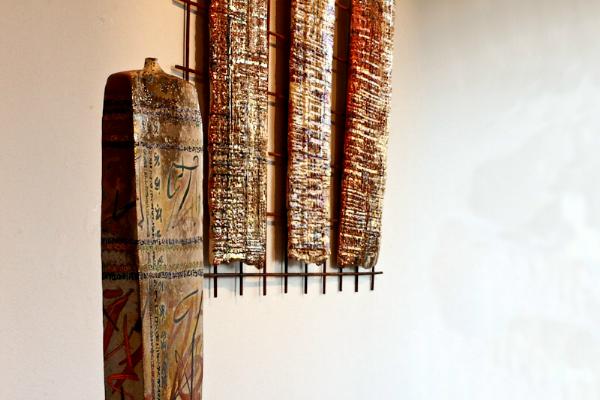
Another source of inspiration for me was the Faculty of Oriental Languages at the University of Venice, where I came into contact with the Islamic culture. I was struck by the way Middle-East iconoclastic culture uses words, mosaics and, in general, signs, to develope its refined graphic sense. I perceived that it was the sign to have the heavy task to substitute figurative images and to reflect the architectural intention of religious places which, contrarily to ours, don’t propose hierarchical spaces, vertically structured to the altar, but, through the infinite playing of arches and columns, aim to the loss of individual boundaries and at the same time to an intimate participation to the ceremony. Thus the sign concurs to create geometries without beginnings nor ends; a graphic and plastic rhythm. My inspiration to the Arabic calligraphy is also connected to the structure of writing, where letters are one-another naturally linked, in a continuous sign, a sort of frieze. It was somehow inevitable, when I approached ceramics, that my curiosity and attraction for Middle-East art emerged. It was again thanks to my uncle (the artist Paolo Staccioli) that I learnt the technique of firing in a reducing atmosphere. This antique technique called “a lustro”, by the use of metallic oxides and the reduction of oxygen in the kiln, allows to obtain brilliant colours which change together with the intensity and direction of the light source.The unpredictability of the result together with the drawing intention, guarantee a surprise and a curiosity always renewing. Some colours, especially the oxides, can produce surprising changes with the variation of parameters like dilution, density and firing temperature. For example, red varies from a tonality of an opaque black with reddish shades, to a bright orange red, up to a green copper. Furthermore, just laying different colours one upon the other, as laying warm colours upon cold colours or vice versa, produces so many variations that inevitably the result will be a unique piece.
Thanks to this tecnique, sign can finally manifest itself with its vitality and its strong dynamism, at the beginning on some mosaics, than on vases. And it is on vases that its intimate nature emerges: that of pre-verbal, germinal sign; a possible representation, a latent intention. The occasional appearance of not completely structured symbols, or of incomplete words, concur to the presage of communication.
The point makes itself movement; while waiting for an intentional synthesis in a verbal-visual image, it swarms of its own motion. Dialogue is possible.