Bruno Munari
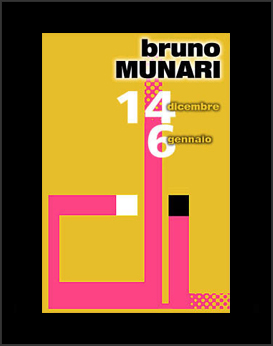
A collective exhibition editions and works of painting, graphics, design, sculpture, games
A real tribute to the Artist as a painter , graphic artist, sculptor, designer, creative educator.
The exhibition includes:
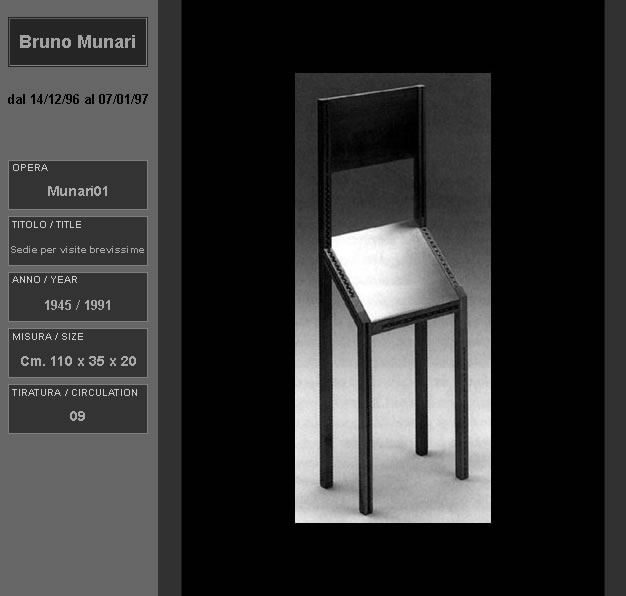
a series of works falling within the different typologies of expressive research a two days' workshopfor children called "Playng with art" at the Gallery (18th and 19th December), and three more days at the Didactic Circles in Colle Val d' Elsa, Poggibonsi, San Gimignano (16/17/18th December). It was possible to arrange such an event with the kind contibution of Prof. Enrico Mussani, one of Munari' closetest collaborators in the field of children' s didacts
an editorial corner thoroughly devoted to the works created by the Artist as well as to titles and editions He authorized an exhibition of the most important audio-visual documents about children' s workshop
Isabella Del Guerra
Munari Timeline
1907 1927 1933 1948 1957 1971 1980...
CHILDOOD
(1907)
Bruno Munari was born in Milan in 1907, but his parents moved soon to Badia Polesine, a village in the Veneto-countryside, on the banks of the river Adige. There, among the machines built by man to interactwith changeable open spaces as to child his own experience in terms of stimuli and suggestions wich have always been a vivid source of ispiratio of him.
MUNARI AND THE FUTURISM
(1927)
At tha age of eighteen, Munari moved to Milan where earnedhis living by working in different graphic arts offices. In 1927, he got in touch with the second stage of the futurist movement, taking part into numerous national and international exhibitions, such as the Diennial Exhibition of Modern Art in Venice (1930, 1934, 1936), the Quadriennial Exhibition in Rome (1935), The Triennial Exhibition in Milan (1936, 1940) and in Paris (1929, 1930, 1932).
THE USELLESS MACHINES
(1933)
In 1930, he approached abstract and airy sculpture; in 1933 he created the first Uselless Machine wich enabied him to become one of the most renowed artists in that period. He pursued his own artistic career by realizing some graphic art works, contibiting to numerous magazines, and illustarting futuristic books.
FROM X TIME TO MAC
(1948)
After the Second War World, Munari created his very first kinstic work (X Time), reproduce by Danese as a multiple copy in 1963. On behalf Mondadori, he came up with an innovatory series of boocks meant for children, and tried to find out new methodologies devoted to children' s didactics. In 1948, he took part into the fondation - in Milan - of the Concrete Art Movement, whit Dorfles, Monnet and Soldati. Being the supporter of an organic kind of art in perpetual evolution, Munari proposed his works as an extremely modern result of interdipliscinary reserches from a plastic, pictorial and architectural viewpoint.
THE FIFTIES AND SIXTIES TOGETHER WITH THE BEGINNING OF HIS INDUSTRIAL PRODUCTION
(1957)
In 1951, Munari created his Negative-Positive and carriedout his first fountain for the Biennial Exhibition of Modern Art in Venice followed by other fountains culminating in the fountain presented in Tokio (1965). Two golden Calipers (1954 and 1955) testified the brand new design characterizing his products on the eve of a co-operation with the firm Denese, for whom he realized whole series of objects well-known world-wide (Cubic ashtray, lamps). From 1956 to 1958, he created his first travel Sculptures in flexible cerdboard, to which followed the sectional sculptures "Continuos structures" in 1961. During that period, he travelled more often abroad, particularly in Japan because of evident cultural affinities. In 1962, he organized, on behalf or Olivetti, the famous art exhibition previously planned; in 1968, he presented a project of minimal habitable room (with Ferges Davanzati and Ranzoni) at the Triennal in Milan.
THE CHILDREN' S WORLD: THE DWELLING-PLACE (1971)
While he kept on working as a graphic artist and as a designer, the children's world acquired more and more importance to him. In 1968, he produced his first didacttic games for Danese, and in 1970/71 he planned for the firm Robots his Dwelling-place, a habitable structure which could be transformed for children: In 1979, the Dwelling-place is only one of a whole series of objects (bookcases, small sofas, etc.) which are still planned and manufactured. Aside from these objects, he created the books meant for childern's author), followed in 1977 by the first "Workshop for children", which is still very much in demand all over the world.
INTERNATIONAL ACKNOLEDGEMENTS AND LATEST WORKS
(1980...)
Munari's creative evolution is studded with acknoledgements testifying his growing international renon. We can mention the prize awared by Japan Design Foundation (1985), the prize given by Accademia dei Lincei for Graphics (1988), honorary degree in architecture conferred by University of Genoa. Munari is currently doing much planning related to design, and his works are reproposed on occasion of collettive exibitions (Biennal Exhibition of Modern Art in Venice, 1986), and of prestigious one-man shows (Tokio, Paris, Jerusalem, Milan).