

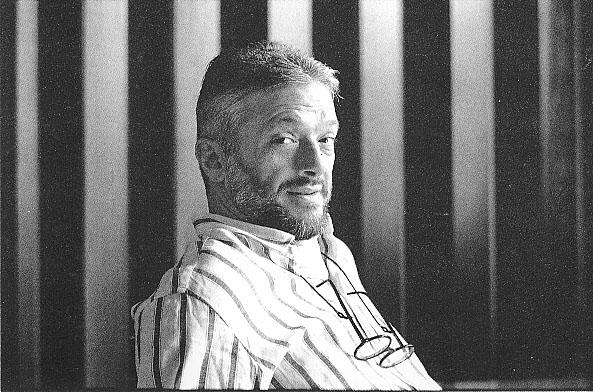
Eros Bonamini exhibited at Galleria Gagliardi from 1994 to 2010.
EROS BONAMINI (1942-2012)
Galleria Gagliardi cooperates with Eros Bonamini, proposing during the years and through three solo exhibitions, a collective one and a catalogue, the artistic path of this great protagonist of the conceptual arts.
“Percorsi/Paths”, an overview on the works of the 70’s with cements and inks.
“Anni ‘90/90’s” chronotopographies: chromatic interventions and canvas eroded by fire.
“Percezioni Relative / Relative Perceptions”, works of a deep research, in which the sign gives way to the trace left by the fire.
With this Solo exhibition titled “Antinomie / Polarities” we are glad to introduce a series of works on stainless steel and plexiglass surfaces, hard and cold matters which interact with reality, involving the spectator and stimulating his curious vanity.
Anti-pictorial matters as steel and plexiglass which under the fire’s strength, they twist and transform in reflection instruments and in intellectual and artistic research.
We could say that the primary material of Eros Bonamini is time. We might say better that each artistic action of his is the search for an object in which can be seen something marking the passing of time, measuring its rhythm, its growth and slowness. In Bonamini's existential experience the passing of time has a particular pregnancy, he waits for the minutes, the hours, the days to pass, together with their heaviness. And in this wait there is almost a sense of impotent inertia which is reacted to with the use of an empirical metronome to mark,not the accelerations, but the diminution of power, not the forming but the spreading of the mark. I would add, though, that this operation, apparently not an aesthetic one, shows an interest in materials that lifts them out of anonimity and has its result a poetical act in the aesthetic sense of the phrase. Licisco Magagnato
Since his debut in the early Seventies, awareness and consistency manifested themselves in the artistic research of Eros Bonamini, together with a continuous research and in a constant planning tension. Not surprisingly, Giorgio Cortenova, the first who clearly read the artist’s work, underlines “(…) an empirical working procedure, nourished by the basic scepticism that is one of the qualifying aspects of our time (…) the never-ending experimenting the field, characteristic of the workability that has become everyday profession, reject ‘tout-court’ of the shocking and artistic gesture (…)”. In 1975 Bonamini exhibited his Tabelle Pittoriche at the “Galleria dello Scudo” in Verona: inaugural works of his entire creative path, monochrome fields,74b one on another in succession, able to call in to question, until the hypothesis of abandoning them, the representative possibilities of painting. Works such as “maps” and recordings of “actual time of doing“, of the tracks that the artist has confirmed over the years, with tools, materials and interventions of different signs; finally, works as verification of experience, the past, the personal and collective history, calculation of individual time in the evolution of universal time.
The series Cementi, tapes and inks made between 1975 and 1978, originate from these basic conceptual assumptions. The artist decides to abandon oil colour, favouring poor materials such as cement and glue, chosen to investigate the hardening process by acting on them with incisions of constant form and pressure: the result is the sequence of tracks that tend to disappearance, little by little, while the drying process is completed. Around 1977, the sign marked on cement is replaced by cloth strips soaked in peroxide (with decolorizing power), immersed in a bath of ink in successive intervals and then exposed, one beside the other, to outline a map of the creative process.
The absorption theme, the interpenetration between ink and surface, which is an active metaphor of space and time values: rejecting the action of painting with increasing firmness, Bonamini chooses the computation of the conceptual action, the verification of its formal transcription and its aesthetic potential.
In the early Eighties, the choice joins the observation and calculation of the canvas ability of imbibing colour, by contact or injection. Initial tools are felt-pens with different tips, which allow verbal narrative iterations connected to workability and time. The second solution is direct injection of diluted colour on canvas.
eros-bonamini_studio
Hence the series of absorption paintings, overcome, in 1983-84, by another cycle of more structured artworks, with signs, colours, writings and gestures pulled together and overlapping in a sort of stratigraphic repertoire of interventions. During the same years, the Cronotopografie arose (literally writings of space and time), made by a series of sequential primary motives – points, lines, Greek fret, signs, labyrinths, spirals and also scribbles – intended to saturate a field. From concentration to rarefaction of scriptures, between the late Eighties and early Nineties, Bonamini lands to large-scale works, on which he tests a varying action: the crucial moment is the unification of individual canvases, in their arrangement on wall and also both in the overlapping and in vicinity.
The important publication and the relative round table at “Palazzo Forti”, Verona, in 1993 is about the artist’s research, from then generally defined Cronotopografie. As Caramel, Veca, Miccini and Cortenova, invited speakers, emphasize, despite the diversity of outcomes Bonamini keeps a similar identity of approach in every work, deriving it from the analytical and conceptual line of the Seventies. Tracking and perfecting the analysis of the constants of his work (always directed to connect the empirical level with the theoretical and speculative ones) the critics further clarify the absence of metaphorical, allusive and symbolic references in his work (which, at first sight, could have been noticed in the supporting forms of spiral, graph and its repetition and of line) but recognizing the priority of “(…) the time of making and the making of matter”, as suggested by Eugenio Miccini, and “(…) relativity to another absolute, similarly excluded by human boundaries: the eternal. As Einstein’s universe, Bonamini fields are unlimited but completed (…) At the regressive mistrust of many ‘minimalist’ grammars, Bonamini enacts what it is narrated, entertains eye and mind on the magnificent absences of truth”.
Once the semiotic and chromatic exuberance decants during the Nineties, the artist continues his research on Cronotopografie in different directions: the pictorial one, characterized by a constant trend towards simplification, acted by minimal and light signs, with a palette dominated by white, deep grey and black; another one made with neutral or coloured plexiglass, where the traces of time are translated into precise sequences of point and labyrinthine scars, or burnt wounds and edges; a further one built with the action fury on the reflecting metals, where the blunt object is the metronome of the repeated and violent action, until foretelling the catharsis of the artist on the matter, while the mirroring and deforming surface increasingly involves the viewer in the process of existence and time consumption in space.
Beside the research on reflective metals differently marked by the action of time, it is possible to find the more recent study on burnt paper and canvases, often circular, superimposed in compositions that consider large diptychs, checking the comparison of language and temporality among paintings, burns, thickenings and rarefactions inside the frames. Cronotopografie intended to re-read the history of art since the second post-war, now investigating the tension toward “beyond” in spatialist key, now claiming the power of language, in a dialectical relationship between matter and sign where time is the common denominator, used by Bonamini in a consistent and always immediately recognizable manner.
More recently it is noticeable the application of neon lights, called to emphasize the passage of time, the creative emphasis and the conceptual rigor of the artist’s action on the support: therefore in the name of a work as a result “(…) of the two entities (the “heat” of sensitivity and the “coldness” of logic) that can be compared with each other (…)”. There could not be better definition except the one offered by Bonamini himself, to close and re-open a reading path on his forty-years long research.
He has been reviewed, among others, by Mario Bertoni, Ilaria Bignotti, Corrado Bosi, Isabella Del Guerra, Luciano Caramel, Claudio Cerritelli, Giorgio Cortenova, Giorgio Di Genova, Gianpaolo Ferrari, Licisco Magagnato, Marco Meneguzzo, Filiberto Menna, Antonella Montenovesi, Patrizia Nuzzo, Anna Maria Sandonà, Toni Toniato, Alberto Veca.
His artworks belong to public and private prestigious collections, among others, the “Galleria d’Arte Moderna e Contemporanea Palazzo Forti” in Verona, the “Mart” in Rovereto, the “Museo d’Arte delle Generazioni Italiane del ¢900 ‘G. Bargellini’” in Pieve di Cento, the “Museion” in Bolzano, the “Museo Casabianca” in Malo.
Essay by Ilaria Bignotti, August 2015
Translation by Chiara Rigolli, March 2016
He has held many personal and collective exhibitions in public and private spaces, including a round table (Giorgio Cortenova, Luciano Caramel, Eugenio Miccini, Alberto Veca) held in 1994 at the "Galleria d'Arte Moderna e Contemporanea Palazzo Forti", Verona with the presentation of the important publication "Eros Bonamini Cronotopografie 1972-1993".
Since 1975 he has exhibited several times at the "Galleria Ferrari" and "Galleria dello Scudo di Verona", followed by other personal exhibitions, "Mercato del Sale" Milan, "Galleria la Polena" Genoa, "Centro Culturale RS" Como, "Galleria Colossi" Brescia, "Valmore" Vicenza, "RossovermiglioArte" Padua.
We remember among the group exhibitions in 1981 "Castello Sforzesco" Milan, "Centre George Pompidou" Paris, in 1982 "Galleria d'Arte Moderna Cà Pesaro" and "Fondazione Bevilacqua la Masa" Venice.
He exhibited several times (1987, 1988, 1990, 2002, 2005) in group exhibitions at the "Galleria d'Arte Moderna Contemporanea Palazzo Forti" Verona.
1998 he took part in "Astratta, Secessioni astratte in Italia dal dopoguerra al 1990" with a catalogue edited by Giorgio Cortenova and Filiberto Menna, a travelling exhibition at: "Galleria d'Arte Moderna e Contemporanea Palazzo Forti" Verona, "La Permanente" Milan, "Kunsthalle Darmstad" (Germany).
In 1998 he took part in the exhibition "Italian artists' books of the twentieth century" at the Museum of Modern Art in New York and in 1992 at the Guggenheim Museum in Venice.
The following have written about him: M. Bertoni, I. Bignotti, C. Bosi, L. Caramel, C. Cerritelli, G. Cortenova, L. Magagnato, M. Meneguzzo, F. Menna, P. Nuzzo, M. Sandonà, T. Toniato, A. Veca.
His works can be found in numerous collections and private collections, including:
Galleria D'Arte Moderna e Contemporanea Palazzo Forti, Verona
Museum of Contemporary Art, Bolzano
Mart Museum of Modern and Contemporary Art, Rovereto.
Mostre personali:
"Chiari & geniali"
VILLA MAZZOTTI
8 percorsi espositivi nell’arte contemporanea
orario: da mercoledì a venerdì: h. 15-19;
sabato, domenica e festivi: 10-12 e 15-19;
Lunedì e martedì chiuso
biglietti: ingresso libero
vernissage: 10 marzo 2007. ore 16.30
Chiari (BS)
dal 10 marzo 2007 al 10 aprile 2007
"L'astratto presente. Generazioni in scena"
Mostra collettiva alla MAGI 900
orario: tutti i giorni dalle 10 alle 18. Lunedì chiuso
biglietti: ingresso libero
vernissage: 24 febbraio 2007. ore 17
Pieve Di Cento (BO)
dal 24 febbraio 2007 al 29 aprile 2007
"... and the stars shine"
Bel Art Gallery
Milano
dal 1 dicembre 2005 al 14 gennaio 2006
"Vanitas Cronotopografie"
Mostra personale di Eros Bonamini, presentata da Marco Meneguzzo. Esposte le opere più recenti. Inaugurazione venerdì 29 ottobre dalle ore 18:30.
My Collection, Verona, Via Sottoriva 12
dal 29 ottobre 2004
"Opere recenti di Eros Bonamini"
Mostra Personale - Evento realizzato in collaborazione con GIBIGIANA ARTE. Venerdì 28 febbraio 2003, alle ore 18:30 inaugurazione con cocktail e Wine Bar. Interverrà il Critico d'Arte Mario Bertoni.
Mobilia International - Via Basso Aquar 28/A, Verona
dal 28 febbraio 2003 al 22 marzo 2003
"Collezione Civica"
Mostra Collettiva - Acquisizioni e donazioni recenti.
L'inaugurazione si tiene nella serata del 25 ottobre.
Galleria d'Arte Contemporanea - Palazzo Forti, Verona
dal 26 ottobre 2002 al 9 marzo 2003
"Grammelot-Cronotopografie"
Mostra Personale - "La pittura di Bonamini è, dunque, volontà di materializzare il tempo concentrando nello spazio dell'opera la durata do ogni visione possibile." Claudio Cerritelli
Galleria Gagliardi, San Giminiano, via S. Giovanni 57
dal Gennaio 2002
"Cronotopografie: A-ulì-ulé"
Mostra Personale - "...un ciclo denominato "Cronotopografie"... dedicato... ancor più... al tempo cosciente ed involontario della mente, con le emozioni e le ragioni che scaturiscono dalle pulsazioni del suo ritmo." Claudio Cerritelli
Immobilia, Verona, viale Del Lavoro, 33
dal 23 Novembre 2001
"Il labirinto della pittura"
Mostra Personale - "...una serie di lavori che dagli anni 70 giunge fino ad oggi con naturale coerenza, un ciclo denominato "Cronotopografie",... dedicato alla individuazione di luoghi ed eventi che dialogano con il tempo interiore ed esteriore della pittura." C. Cerritelli
Centro d'arte La loggia, Monte Ridolfi, Firenze
dal 26 ottobre 2001
Pagina 1 di 1 (9 elementi)1969
Galleria Libreria d'Arte Dante, Verona
1975
"Le tabelle pittoriche di Eros Bonamini", Galleria Dello Scudo, Verona
Galleria Ferrari, Verona
1977
Galleria Ferrari, Verona
1979
Centro Culturale RS, Como
Centro Culturale Santelmo, Salò, Brescia
1981
"Indicare", Centro Culturale RS, Como
1984
Galleria d'Arte Moderna e Contemporanea Palazzo Forti, Verona
1988
"Cronotopografie", Mercato del Sale, Milano
1989
"Pulsione mediterranea", Galleria Ferrari, Verona
1991
Arte Fiera Bologna, Galleria Ferrari, Verona
1994
Galleria d'Arte Moderna e Contemporanea Palazzo Forti, Verona
"Cronotopografie", opere recenti, Galleria Cinquetti, Verona
"Cronotopografie 1980", Galleria La Polena, Genova
"L'attenzione all'oggetto", Galleria Cinquetti, Verona
1995
"I segni le tracce", Sale Carlo Anti, Comune di Garda, Verona
"Percorsi", Galleria Gagliardi S. Giminiano, Siena
1997
"Il labirinto della pittura", Palazzo Datini, Prato
22 ottobre - 19 dicembre 2011
"con_tempo", Colossi Arte Contemporanea, Brescia
1976
"L'esplorazione percettiva", Palazzo della Ragione, Bergamo
1978
"Una definizione di segno", Galleria Ferrari, Verona
1979
"A proposito di realtà restituita", Galleria Due Torri, Bologna
"99 sculture di artisti contemporanei italiani e stranieri", Galleria Lorenzelli, Bologna
1980
"Liber" Biblioteca Comunale A. Lazzarini, Prato
1981
"Livres d'artistes livres obiets", Galleria NRA, Parigi
"Il materiale delle arti", Castello Sforzesco, Milano
"Art Shop", Galleria Puntounoarte, Noverate, Como
1982
"Proposta", Parco Massari, Ferrara
"Proiezioni 80", Galleria d'Arte Moderna, Cà Pesaro, Fondazione Bevilacqua, La Masa, Venezia
1983
"1.000 volte 1983", Castello di Lerici, Lerici
"Opera aperta", Centro Arti Plastiche, Comune di Udine
"Una pittura inquietante", Museumpavillon, Salisburgo
"Verona sessantottanta ", Palazzo Massari, Ferrara
1986
"La pittura italiana degli anni 70", Galleria Ferrari, Verona
"Quadreria", Centro Culturale RS, Como
"Sconfinamenti", Kunstlerwerkstatten, Lothringer Strasse, Monaco, Germania
"Città di Monza", Villa Reale, Monza
"La scienza dell'arte", Bevilacqua, la Masa, Venezia
"Qui senza confine", Galleria Ferrari, Verona
1987
"Biennale Nazionale d'Arte Contemporanea di Piacenza", Piacenza
"Arte in rivolta", Hotel Salinel, Comune di Nimes, Francia
"Maestri italiani contemporanei nella collezione civica", Galleria d'Arte Moderna e Contemporanea A. Forti, Verona
1988
"Anni 70", Galleria Ferrari, Verona
"Astratta", Galleria d'Arte Moderna e Contemporanea A. Forti, Verona, La Permanente, Milano, Kunstalle Drmstadt, Germania
"Il tempo e il tempio", Comune di Montichiari, Brescia
"Old carpets e modern artists", Il mercante d'Oriente, Verona
1990
"L'uomo l'albero il fiume", Castel Ivano Incontri, Trento
"Dal bianco al nero", Galleria d'Arte Sacripanti, Cantù, Como
"Irrituale", LX Biennale Nazionale d'Arte di Verona, Palazzo della Gran Guardia, Verona
1991
"Collezionare... è bello", Galleria Ferrari, Verona
"Pittura a Verona 1976 - 1991", Biblioteca Comunale di Sona, Sona, Verona
"Prospettiva italiana", Galleria Ferrari, Verona
1992
"The artist and the book in twentieth-century Italy", The Museum of Modern Art, New York
Galleria Ferrari, Verona
1993
"Caro Marcel, ...", Galleria La Giarina, Verona
"Le materie inventate", Museo d'Arte Moderna dell'Alto Mantovano, Gazoldo Degli Ippoliti, Mantova
"Caro Marcel", Eros Bonamini-Eugenio Miccini, Galleria Il Traghetto, Venezia
"Maestri italiani nella collezione civica", Galleria d'Arte Moderna e Contemporanea - Palazzo Forti, Verona
"15x15 e 20x20", Galleria Il Traghetto, Venezia
1994
Arte Fiera Bologna, Galleria Il Traghetto, Venezia, Il Fioretto, Padova
"I libri d'artista italiani del novecento", Guggenheim, Venezia
Arte Fiera Basilea
1995
"Multiplomania", Galleria Cinquetti, Verona
"Sordello da Goito", Palazzo Municipale di Goito, Mantova
1996
"Settima Biennale d'Arte Sacra", Santuario di S. Gabriele, Isola del Gran Sasso, Teramo
1997
"Il catalogo", Ente Fiere Verona, Verona
"Un libro da appendere", Galleria Ducale, Mantova
1998
"L'Arlecchino mantovano", Palazzo Comunale, Mantova
"Musica e nò", S. Maria della Scala, Siena
"Musica e nò", Palazzo Ducale, Mantova
"Segni ritmici", Il Mercante d'Oriente, Verona
"Musica e nò", Biblioteca Centrale, Firenze
"Unitled 98", Fiere di Verona, Verona
1999
"Città di Lissone premio di pittura", Lissone, Milano
Throughout his research on Time-Space-Matter, which Eros Bonamini performed with great energy, the painter investigated every conceptual aspect, every type of intervention pertaining to matter. Each experiment gave life to works in which signs symbolize a transformation process by which each trace shows the passing time. But perhaps these works are even more intense. The signs and traces, which are characteristic of Bonamini’s work but original in their execution; new traces, new signs which, through matter’s combustion and transformation, create three-dimensional spaces as yet undiscovered. I admire the defacement of matter by fire, this steel which bends to the will of heat reminding us of deformed and kaleidoscopic images. This mirrored surface prompt us to take part in a game of altered images in which the reflected image is in itself a relative perception.
Isabella Del Guerra, 2006
Galleria Gagliardi cooperates with Eros Bonamini, proposing during the years and through three solo exhibitions, a collective one and a catalogue,
the artistic path of this great protagonist of the conceptual arts.
“Percorsi/Paths”, an overview on the works of the 70’s with cements and inks.
“Anni ‘90/90’s” chronotopographies: chromatic interventions and canvas eroded by fire.
“Percezioni Relative / Relative Perceptions”, works of a deep research, in which the sign gives way to the trace left by the fire.
With this Solo exhibition titled “Antinomie / Polarities” we are glad to introduce a series of works on stainless steel and plexiglass surfaces,
hard and cold matters which interact with reality, involving the spectator and stimulating his curious vanity.
Anti-pictorial matters as steel and plexiglass which under the fire’s strength,
they twist and transform in reflection instruments and in intellectual and artistic research.
Isabella Del Guerra, 2009
L'EQUILIBRIO DEGLI OPPOSTI
Amburgo
From 18/09/2009 to 18/12/2009
More Info
PERCEZIONI RELATIVE
San Gimignano
From 11/02/2006 to 16/03/2006
More Info
IL LABIRINTO DELLA PITTURA
PRATO
From 08/03/1997 to 30/03/1997
More Info
Percorsi
San Gimignano
From 23/09/1995 to 14/10/1995
More Info
Eros Bonamini
Edizioni Gagliardi - 2009
Download PDF - Pag.46